
Understanding Absorption Rates in the Charlotte Housing Market
When buyers or sellers ask me whether we're in a buyer's market or a seller's market, my answer is usually, "It depends on where you're looking."
Charlotte isn't one real estate market. It's a collection of neighborhood markets, price ranges, and property types, each moving at its own pace. One of the best tools for understanding those differences is something many consumers have never heard of: the absorption rate.
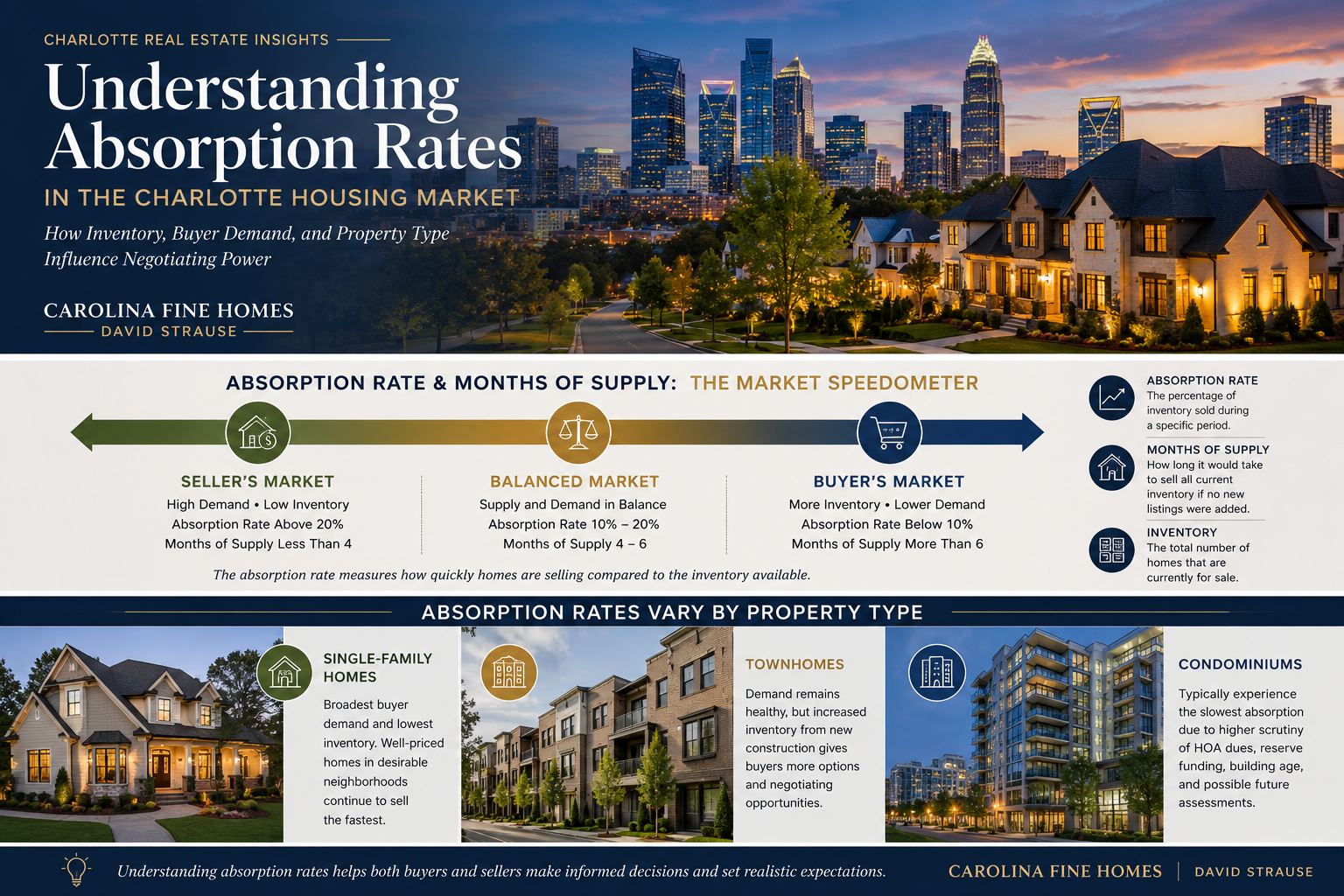
Although it sounds technical, the concept is straightforward. The absorption rate measures how quickly buyers are purchasing the available homes on the market. Think of it as the market's speedometer. The faster homes are selling, the stronger the demand. As inventory grows faster than buyers are purchasing homes, the market begins to slow and buyers gain negotiating leverage.
Closely tied to absorption is another statistic called months of housing supply. This measures how long it would take to sell every home currently on the market if no new listings were added.
Economists typically view four to six months of inventory as a balanced market. Below that range, sellers usually hold the advantage. Above it, buyers gain increasing leverage.
For much of the past several years, the Charlotte region has remained below that balanced range. Inventory increased during 2024 and 2025, giving buyers more choices than they had during the pandemic-driven housing boom, but supply still remained below the level considered a true buyer's market.
Not All Property Types Behave the Same
One of the biggest misconceptions I see is the assumption that every segment of the Charlotte market moves together.
It doesn't.
Single-family homes, townhomes, and condominiums each have their own buyer pool, inventory levels, and absorption rates.
Single-Family Homes
Detached homes continue attracting the broadest buyer demand throughout the Charlotte region. Families relocating for work, move-up buyers, and buyers seeking more privacy all compete for this segment.
Because demand remains strong and inventory is still relatively limited, well-priced single-family homes in desirable neighborhoods often move quickly.
This is especially true in neighborhoods such as Myers Park, SouthPark, Foxcroft, Eastover, Barclay Downs, Lansdowne, Montibello, Mountainbrook, Beverly Woods, and Cotswold.
When inventory is limited, sellers maintain more negotiating power, particularly for updated homes in prime locations.
Townhomes
Townhomes occupy a very different position in today's market.
Demand remains healthy, especially among executives, downsizers, first-time luxury buyers, and relocating professionals seeking low-maintenance living. At the same time, new construction has expanded the number of available townhomes across several Charlotte submarkets.
As inventory increases, buyers have more opportunities to compare floor plans, HOA fees, amenities, locations, and monthly ownership costs.
That additional competition often creates greater pricing flexibility than buyers see in the detached home market.
Condominiums

Condominiums frequently experience the slowest absorption of the three major residential property types.
Condo buyers evaluate much more than the home itself. Monthly HOA dues, reserve funding, building age, insurance costs, amenities, rental restrictions, and the possibility of future special assessments all influence purchasing decisions.
For that reason, buyers typically spend more time comparing options before making an offer.
Premium condominiums in desirable locations—particularly SouthPark, Uptown, and portions of Dilworth—continue attracting strong demand. Even so, the condo market often carries more available inventory than detached homes.
Why This Matters to Buyers
Understanding absorption rates helps buyers recognize where they may have greater negotiating leverage.
If inventory is increasing and homes are taking longer to sell, buyers often have opportunities to negotiate:
Purchase price
Seller-paid closing costs
Inspection repairs
Extended due diligence periods
Flexible closing dates
The strongest negotiating opportunities often appear in segments where inventory has expanded faster than buyer demand.
Why This Matters to Sellers
Absorption rates are equally important when pricing a home.
When inventory is building and buyer activity slows, accurate pricing becomes even more important.
One of the biggest pricing mistakes I see is assuming last spring's comparable sale still reflects today's market. Markets evolve continuously. Inventory, competing listings, mortgage rates, and buyer confidence all influence how quickly homes sell.
Properties priced correctly from the beginning create momentum.
Homes priced above market frequently experience fewer showings, longer marketing times, and multiple price reductions before attracting serious buyers.
Every Neighborhood Has Its Own Absorption Rate
One reason I spend so much time studying neighborhood data is because broad market headlines rarely tell the whole story.
A luxury home in Myers Park behaves differently than a SouthPark condominium.
A renovated bungalow in Plaza Midwood attracts a different buyer than a townhome in Ballantyne.
Even within the same neighborhood, absorption rates can vary by price range, property age, condition, and school district.
That is why I prepare neighborhood-specific market analyses rather than relying solely on regional statistics.
The Bottom Line

Absorption rates don't predict the future, but they provide one of the clearest snapshots of what's happening right now.
They help explain why one home receives multiple offers while another sits on the market.
They help buyers recognize when negotiating opportunities may exist.
They help sellers understand why strategic pricing matters more than ever.
Most importantly, they remind us that Charlotte is not one housing market. It is a collection of hundreds of individual markets, each moving at its own pace.
Understanding those differences is one of the biggest advantages a knowledgeable local real estate professional can provide.
If you're thinking about buying or selling in the Charlotte area, I'd be happy to prepare a neighborhood-specific market analysis that includes current inventory levels, absorption rates, pricing trends, and buyer activity for your particular area—not just the Charlotte market as a whole.
Contact David Strause
David Strause
Ivester Jackson | Christie's International Real Estate
📞 704-437-2023
📧 DavidS@IvesterJackson.com
🌐 https://www.carolinafinehomes.com